Legal Weed: The Low Down in Sac Town

weed

As a lobbyist for a variety of industries, I have to admit that working within the cannabis space is thrilling. It is not often that one gets an opportunity to actively influence an entirely new sector, particularly when so much is happening so quickly.

And it can be kind of a whirlwind to understand if you’re not immersed in it.

At this point, most folks are aware that the people of California legalized recreational cannabis with the passage of Proposition 64 last November. What they may not be aware of, however, are the deliberative steps the City of Sacramento has been taking to ensure that it’s done right — and they’re doing a lot.

Let’s start with how we got here.

The medical sale of cannabis to qualified patients has been legal for quite some time, 21 years in fact. The industry was left largely unregulated during those years, and it wasn’t until 2015 with the passage of a package of bills entitled the Medical Cannabis Regulation and Safety Act (MCRSA) that a more formalized regulatory structure was put in place. These laws set forth the requirements for everything from packaging and labeling, to taxation, to what licenses are available including dispensaries, distributors, and cultivators. Then Proposition 64 passed in 2016, and suddenly the state, cities, and counties were handed a very tight timeline to figure out how to regulate recreational weed too.

Now, it’s 2018 or bust.

According to the law, California has until January 1, 2018 to develop a process for licensing both medical and recreational cannabis businesses. In the last few months, the Governor and Legislature passed two bills that helped streamline the process. The first combined medical and recreational laws into one in order to avoid duplicative work and inefficiencies (there’s really no need for two separate processes). The second clarified the issues that remained unaddressed in the first, such as whether or not businesses can sell both medical and recreational cannabis in the same location (they can).

Now that these laws are in place, the agencies in charge of creating the detailed regulations – such as how much cannabis you can sell to one person, or how much security you’re required to have – are fiercely writing away to ensure those are in place before January of next year. So, we’re all good, right? Seems like the work is underway and we can all go buy special brownies to celebrate in January…well, not exactly.

Cities and Counties are calling the shots.

One of the more prominent requirements of the law is that the ultimate power over whether or not – and how – cannabis is regulated rests in the hands of local governments. This means 58 counties and hundreds of cities can give the thumbs up or down, and even determine what’s allowable. For instance, the County of Marin is considering only allowing cannabis delivery businesses, while the County of Sacramento has banned commercial sales altogether in the unincorporated parts of the county.

This makes things very, very complex if you’re a business that’s hoping to operate statewide. The law requires that you submit proof of local authorization (i.e. that you’re allowed to be there) in order to obtain a state license. That is a huge road block considering many local governments haven’t even begun the process of deciding whether or not they will allow cannabis sales, and many more are waiting to see what others do first.

Luckily for us, the City of Sacramento is not waiting, they’re leading.

Sacramento’s Cannabis Czar (more formally known as the Chief of Cannabis Policy and Enforcement), Joe Devlin, has no enviable job. While simultaneously waiting for the state to determine their rules, the city has also been charting its own path into the unknown, and there’s no guide book. Sacramento currently has 30 storefront dispensaries (and that number is unlikely to change any time soon), and is accepting applications for both cultivation and manufacturing.

After months of community stakeholder meetings and hearings, they are set to develop plans for delivery and distribution in the coming months, and may even hold discussions for on-site consumption and the potential of “cannabis cafes” as soon as early 2018. These are “high times” (pun intended) for the industry, city officials, consumers, and city coffers alike. Dispensaries alone brought in millions of additional revenues last year.

So, I can buy recreational weed in January, right?

Nope, sorry. And there is no clear timeline for when that might happen. While the city is a leader in regulating medical cannabis, they are also taking precautions. It appears that city officials would prefer to finish laying out what the rules will look like for medical first before tackling the recreational market. So, while it is legal to consume cannabis without a doctor’s recommendation, the City of Sacramento will not be the place to buy legal recreational weed…at least any time soon.

Is it too late to get involved in the process?

Quite the opposite. There are still many opportunities to have your voice heard on the sale and use of cannabis in Sacramento. The city is currently holding community discussions in each council district, stakeholder meetings at city hall, and will vet each proposal through the law and legislation committee, budget and audit committee, and planning commission before being voted upon by the city council. The Planning Commission will be discussing delivery dispensaries, distribution, and background checks at their October 26th meeting, and those are expected to be voted on by the city council on November 21st.

You can visit the City of Sacramento cannabis page for the most up-to-date information.

Upcoming Meetings:

September 27 | 5:30 – 7 pm | District 3 Neighborhood Workshop

October 5 | 5:30 – 7 pm | District 8 Neighborhood Workshop

October 23 | 2 – 4 pm | Stakeholder Meeting

October 24 | 3 pm | Law and Legislation Committee Meeting

November 7 | 2 pm | Budget and Audit Committee Meeting

November 16 | 2 – 4 pm | Stakeholder Meeting

November 21 | 5 pm | City Council Meeting

Making Your Voice Heard at City Hall

CityHall

Since the results of the presidential election, I’ve met a lot of Sacramentans who want to get more engaged in local politics and public policy. This is wonderful news! Generally, few people pay attention to what’s going on at City Hall, even though local decisions – be it on land use, policing, or street maintenance – have a very direct impact on residents’ day-to-day quality of life.

For example, a recent study by the Advancement Project  found that only one-in-ten Californians  contacted a public official in the past year;  nine-in-ten Californians had not even attended a “meeting where political issues are discussed.”

That’s a lost opportunity for a number of reasons. First, citizen engagement can make a big difference at the city level. No really. In a recent survey of California city officials, over 80 percent agreed that “preferences emerging from public deliberation had an impact on final decisions.” I’ve witnessed and heard the same from councilmembers.

Equally important, if civically-minded citizens never show up, someone else will fill that vacuum. In the same survey, 76 percent of city officials report that public meetings are “typically dominated by people with narrow agendas.” Yikes.

Finally, civic engagement can be personally fulfilling! Again, really. Science even says so. Civic engagement, particularly when done with neighbors or as part of a group, builds community and can increase people’s sense of life satisfaction.

And, the good news is, in Sacramento it is especially easy for citizens to advocate for local policy change. So, as someone who works in the government transparency field, here’s my quick primer on how to make your voice heard at City Hall.

  1. Meet Your Councilmember.

One of the very best ways to affect change is to speak directly with your councilmember. On any given day your average councilmember has dozens of policy issues jostling for their attention: a one-on-one conversation can elevate your issue above the noise. A 30-minute conversation can also cover more ground and leave a more lasting impression than a typical letter.

Unlike your congressperson or state legislator, who represent so many residents that substantive personal contact with constituents is near mathematically impossible, I’ve found Sacramento city councilmembers and their staff to be very accessible. Most are eager to have coffee with a constituent they have not had the opportunity to hear from before. To request a meeting, call (916) 808-5300 and ask to speak to your councilmember’s scheduler. Try and set things up at least two to three weeks in advance and understand they are doing their best to fit you into a very busy schedule. You will probably be asked to email over a one to two paragraph description of what you’d like to discuss to help make the meeting as productive as possible.

Sometimes councilmembers just will not have time to meet. Don’t get discouraged! Many councilmembers have community office hours or attend neighborhood meetings (often noticed in their newsletter, which you should sign up for!) where you’ll have an opportunity to speak with them without a formal meeting. In addition, each councilmember has two to three staff who advise them on policy matters: a meeting with staff can be equally valuable, especially because they will often have more time to consider your concerns.

  1. Email your councilmember.

The fastest way to let your councilmember know what you think is to email or call them. Most councilmembers personally read the email you send them, unfiltered by staff, so this can be a very effective way of letting your direct representative know your concerns. Here is the official contact information for every councilmember:

What’s that — not sure who your councilmember is? Don’t worry, you are far from the first. The city has a helpful council district locator tool here. Simply enter your street address and the tool will spit out your district and councilmember!

  1. Speak at a Council Meeting.

Dais

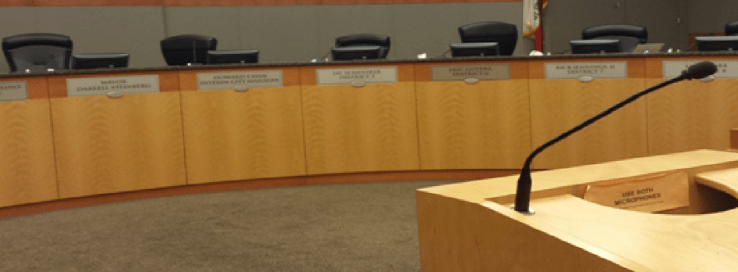
Most changes in city policy are decided by the city council at a public meeting. If the change is being done through a city ordinance, it will first have to be discussed at the city council’s Law & Legislation Committee (affectionately called “L&L”), which vets policy changes before they go to the full City Council for a vote. With both City Council and L&L meetings, the public is given the opportunity to directly address decision-makers on any item before they vote.

The hardest thing is to know when an item you are interested in is coming before the council. City council and standing committee agendas are posted five days in advance on the city’s website. In this case, that means on Thursdays by 5:00 p.m. for both the City Council and L&L. Unfortunately, there is presently no way to subscribe to council agendas by email (RSS is available), so you either need to monitor the council’s agenda weekly or, if there’s a particular upcoming issue you are interested in, ask your councilmember or the city clerk when they expect that issue to come before the council.

You must appear in person to speak at a meeting. The city council generally meets weekly on Tuesdays at 5:00 p.m. in the New City Hall council chambers, located at 915 I St. The Law & Legislation Committee typically meets every second and fourth Tuesday at 3:00 p.m. also in council chambers. The city clerk maintains an up-to-date calendar of council and standing committee meeting dates online.

To comment, you must first complete a speaker slip and hand it to a city clerk staffer who will be conspicuously seated at a desk on the left side of the room, in front of the council dais. Speaker slips and pencils are available on a counter at the back of the city council chamber. However, you can also download, print, and complete a speaker slip at home and bring it to the meeting. The most important thing is to look up the item number you want to speak on in the agenda and mark it on your speaker slip; otherwise the city clerk will not know when to call you up to speak. If you are at all confused, there are lots of staff around who are happy to help.

When you are called, you will have two minutes to speak. A timer on a screen in front of you will count down the time you have left. Once your time is up, you need to quickly wrap up your comment in about 5-10 seconds or the meeting chair may cut you off. Remember that council meetings can drag on late into the night and it’s hard to predict when an agenda item will come up … be prepared to wait a few hours and bring a good book!

  1. Submit a Written Comment.

Another way to get your views before the council at a meeting is to submit an electronic comment. The “eComment” feature is conveniently located next to where the agendas are posted. Simply click on the eComment button, scroll down and select the agenda item you wish to comment on, and then write your message. Electronic comments are made available to councilmembers at the dais as agenda items come up.  Because it is fully electronic, you can even submit an eComment up to 15 minutes before the start of the meeting and it will be included as part of the official record.

eComment

eComment presently only accommodates 1,000 characters of text (or about 7 tweets), so keep your comment pithy.

  1. Join a Group!

As the saying goes, there is strength in numbers. There are many groups that are active in trying to make the City a better place. Joining a group is a good way to become aware of what’s going on, be a part of a community, and effectuate change. There are so many groups out there for people of every political stripe, here are just a few your Sacramentality Team are proud members of:

  • League of Women Voters: For the past few years I have been a member of the local chapter, which works to promote honest, ethical, and transparent government. We recently partnered with the City Council and Common Cause (where, full disclosure, I work!) to create a City Ethics Commission, Ethics Code, and Redistricting Commission — one of the most significant local governance reform packages in the state.
  • Local Democratic Clubs: Sacramento is a Democratic town, and as the state capitol an especially political town. The County Party has a list of almost two dozen local Democratic clubs, many of which are active at the City level. For example, Caity is the Fundraising Director for the Fem Dems of Sacramento, which recently advocated for the City to take a closer look at its diversity practices to ensure its workforce is diverse and equitably paid.
  • Neighborhood Associations: Want to meet your neighbors, beautify your street, get speedbumps installed, and discuss the City’s crime prevention strategy? The City has dozens of neighborhood associations across the City that do just that each year. Associations tend to have close relationships with councilmembers and can be good catalysts for change. For example, Devin co-founded and is a board member of the Pocket-Greenhaven Community Association, where he has hosted a number of community events and advocated for funding for community priorities.

***

As this short list indicates, there are so many ways to be civically active in our City. How are you civically active in Sacramento?

Is there a tip that should have made this list? Let us know in the comments below.